

A cozy living room is not a style category. It is a room that holds people comfortably after the lights go down a notch: seating close enough to talk, light that does not glare, surfaces that take a mug, and enough empty space that the eye can rest.
This guide is a working sequence, not a shopping list. It starts with how the room is used, then furniture, then light, then color and texture. It does not assume a renovation budget, a designer, or a house with extra square footage. If you rent, you can still do most of it. The wider set of room notes lives on the Cozy Living Room Ideas hub.
For layouts in tight rooms, use the companion small-space layout guide. For light specifically, see how to layer living room lighting.
What cozy actually means in a living room
People use “cozy” to mean three different things, and mixing them up wastes money.
The first is physical comfort: a seat you can sit in for an hour, a place to put your feet or a drink, a temperature that does not fight you. The second is visual softness: warm light, mixed textures, colors that do not bounce around the room. The third is social comfort: furniture that faces other people instead of only the television.
A room can look styled and still feel cold if the sofa is too far from the chairs, if the only light is a ceiling disc, or if every surface is hard. A room can also feel crowded and still fail at cozy if every surface is busy. Cozy is closer to “settled” than to “decorated.”
Start by naming the room’s real jobs. Most living rooms do two or three of these: evening sitting, television, reading, kids’ play, guests, and a pass-through to the kitchen or hall. Write those jobs down. A room that tries to do all six at full volume usually does none of them well.
Read the room before you buy anything
Walk the room at the hour you actually use it. Note the window direction, the glare on the TV wall, the doorway people cut through, and the outlet locations. Measure the long wall and the short wall. Measure the sofa you already own, including arm depth. Those numbers matter more than a mood board.
Leave a walking lane of about 30 to 36 inches where people already walk. If the only path to the kitchen crosses the conversation group, the furniture will always feel in the way. In a small room that path may have to skim the sofa back. That is fine if the seating cluster itself stays tight.
Look at what already works. A tired sofa in the right place beats a new sofa shoved against the wrong wall. A lamp you already own, with a warmer bulb, will change the room faster than a new accent chair.
Pull furniture into a conversation group
The most common layout mistake is lining every piece up against a wall. That opens the center of the room and makes sitting feel like waiting in a lobby. Cozy seating faces other seating across a distance you can talk over without raising your voice, usually in the 6 to 10 foot range between seat fronts.
A simple group is a sofa, a coffee table, and one or two chairs. The coffee table should sit about 14 to 18 inches from the sofa seat so you can reach it without standing. Chairs can share that table or get a small side table of their own. If the room is long and narrow, put the sofa on the long wall and keep the chairs inside the same rug rather than sending one chair to a far corner.

Television placement should follow the seating, not the other way around. If the TV wall forces every chair into a row, the room will watch well and talk poorly. Angle one chair, or accept that the TV sits slightly off-center. A living room that only works when the screen is on rarely feels like a place to stay.
Rugs help the group read as one place. The front legs of the sofa and chairs should land on the rug. A rug that floats like a stamp under the coffee table makes the furniture look scattered. In a small room, a larger rug is usually calmer than a tiny one.
Light the room in layers, not from one point
A single overhead fixture flattens faces and walls. Cozy light comes from at least two heights: a lamp near seating and another source across the room, with the ceiling light dimmed or off in the evening. Aim for warm bulbs in the living room, generally in the 2700K range, so the light matches lampshades and wood instead of office ceilings.
Put the first lamp where someone sits to read or talk. Put the second lamp in the darkest corner, not next to the first. If you only add one thing this month, add that second lamp. The lighting guide covers shade height, dimming, and why cool-white ceiling bulbs work against the rest of the room.
You do not need smart bulbs to do this. A dimmer, a three-way lamp, or a plug-in lamp on a simple timer is enough. The point is control at night, not a product stack.
Use color to quiet the room, not to theme it
Cozy palettes are usually low contrast on the large surfaces and a little richer on the things you touch. Walls in a warm greige, clay, or muted olive give lamps something to land on. A bright cool white wall can look clean at noon and harsh at 8 p.m.
Keep large pieces related: sofa, rug, and curtains should share a temperature, warm with warm or cool with cool. Then add one deeper accent in a throw, a pillow, or a lamp base. Four competing accent colors read as clutter even when the room is tidy. The palette guide walks through four combinations you can test with samples before paint.
Paint is optional. If you rent, shift the large textiles first. A warmer rug and curtains will do more than a new pillow pattern.
Add texture in a few large moves
Texture is what keeps a neutral room from feeling empty. You do not need ten materials. Three is plenty: a knit or wool throw, a rug with visible pile or weave, and one wood or ceramic surface that is not painted.
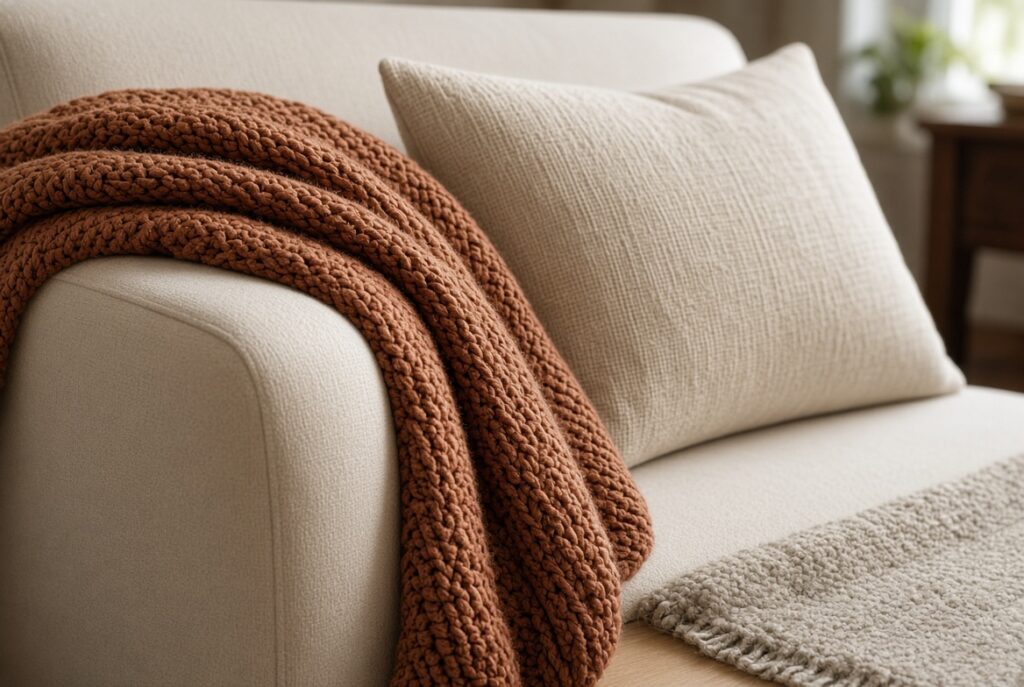
Scale matters. One substantial throw looks calmer than five tiny pillows. A wood bowl on the coffee table looks calmer than a tray of miniature objects. If you like collections, give them one shelf or one box, not every horizontal plane.
Softness should be where bodies are: seat cushions that have some give, a throw you will actually pull over your legs, a rug that is not icy under bare feet. Decorative texture that you are afraid to touch is just visual noise.
Edit the surfaces that collect stuff
Coffee tables, console tops, and sofa arms collect the week. Cozy rooms still have books and remotes. They do not have twelve objects competing for the same square foot. Leave at least a third of the coffee table clear so a plate or a laptop can land.
Storage that looks like furniture helps: a lidded basket for throws, a side table with a shelf, a console with doors. Open baskets work if they hold one category. Mixed overflow in a pretty basket is still overflow.
If the room already feels busy, stop adding and use the mistakes guide as a checklist. Most “I need more decor” problems are layout, light, or too many small things.
A weekend sequence that actually changes the room
Do this in order so you do not buy against a bad layout.
- Clear the coffee table and the floor path. Put stray items in one box for later.
- Move seating into a tighter group. Pull the sofa off a long empty wall if that lets chairs face it.
- Place a rug so the front legs of the main seats sit on it.
- Add or relocate two lamps. Change overhead bulbs to a warmer temperature if they are cool white.
- Add one throw and edit pillows down to two or three.
- Put three objects on the coffee table, not ten. Live with that for a week before shopping.
If the room still feels cold after that sequence, the next lever is usually wall color or window treatments, not another accent chair. If it feels cramped, the next lever is furniture size or the walking path, not more storage cubes in the middle of the floor.
Budget notes without a product list
Spend first on the thing that touches the most hours: a lamp you will turn on every night, a rug large enough to gather the seats, or a sofa that does not punish your back. Paint is cheap relative to furniture if you own the walls. Curtains that reach the floor and are wider than the window usually look better than short cafe panels, even in inexpensive fabric.
Skip themed seasonal sets if the base room is not settled. A winter throw on a well-placed sofa looks intentional. A crate of autumn objects on a crowded table does not.
Secondhand furniture is fine in this kind of room. Wood with worn edges often looks more at home than a matching boxed set. Check seat height and depth in person when you can. Online dimensions lie in small rooms.
How to know the room is working
The test is evening use, not a photograph. If two people can sit and talk without moving a chair, if you can read without the ceiling light, and if you can set a drink down without rearranging objects, the room is doing the job. Photographs can wait.
Revisit the room after a week of normal life. Notice where piles return. That spot needs a home or a rule, not another decorative tray — the same pattern shows up in clutter mistakes that crowd a room. Notice where you never sit. That chair is in the wrong place or the wrong scale.
From here, go deeper on the piece that is still failing: layout, no-remodel warmth, color, or lighting.
