
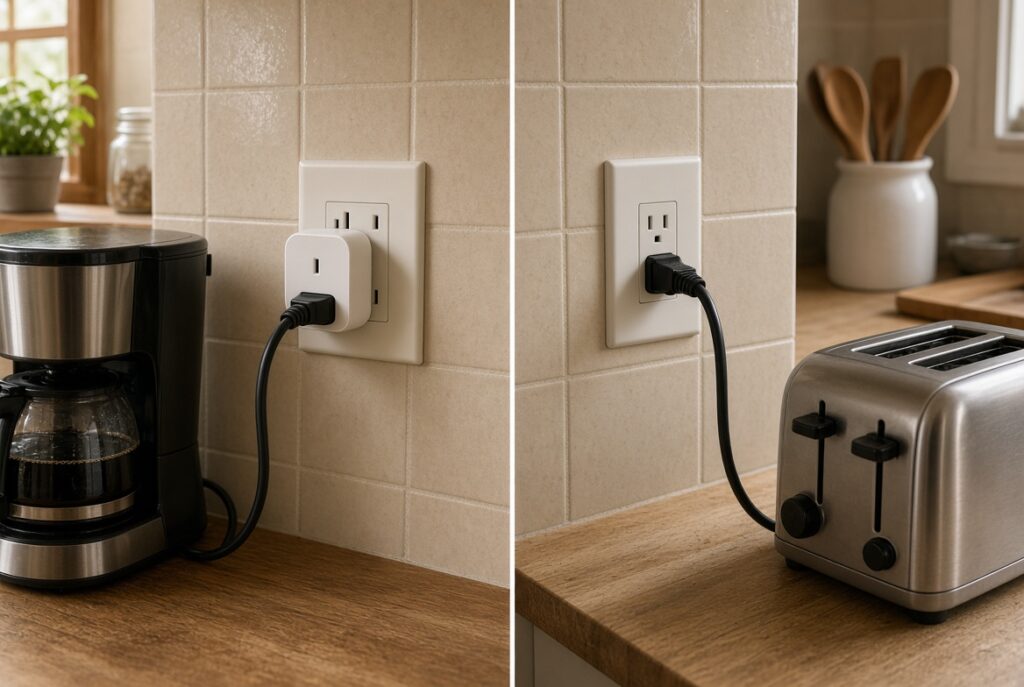
A smart plug and a smart outlet solve the same household problem: they add a remote switch to a receptacle. They do it in opposite ways. The plug is a guest. The outlet becomes part of the wall. Choosing poorly usually means a bulky adapter you hate to look at, or an electrical project you did not want.
This is a decision guide, not a product test. Use it to pick a path before you buy either device. Hardware choice is one slice of the Smart Plugs collection.
The mechanical difference
A smart plug leaves the existing receptacle in place. You insert the module, then insert the appliance cord into the module. Installation is reversible in seconds. The cost is bulk. The plug stands off the wall and can cover the second socket on a duplex plate.
A smart outlet replaces the receptacle. After a breaker is off and the device is wired, the wall looks almost ordinary. The appliance cord goes straight into the new receptacle. Installation is slower and, in many regions, may require a qualified electrician. It is also a poor fit for most rentals.
Decision criteria that actually matter
Housing situation
If you rent, start with a plug. You can take it when you move. You do not alter wiring. You do not argue with a lease about in-wall devices. A homeowner can still start with a plug and upgrade later.
How visible the outlet is
An outlet beside a sofa is a poor place for a chunky adapter. An outlet behind a media console can hide a plug completely. Walk the room before you decide. Visibility is a design issue, not a technical one.
How permanent the appliance is
A floor lamp that might move next month wants a plug if you are testing a simple lamp schedule. A hallway sconce that will stay for a decade is closer to in-wall work, or to a smart switch on the controlling circuit.
Load
Read both ratings. Many plugs and many in-wall outlets share a 15A class. Some in-wall devices offer a 20A path on a 20A circuit. That is not a reason to put a heater on either device. It only means the wall device can sometimes match a heavier dedicated circuit.
Second socket
A duplex receptacle is two sockets. A fat plug can steal both visually even when one still works. An in-wall smart outlet can keep two sockets and make only one of them switched, depending on the model. If you still need an always-on neighbor socket for a clock or router, check that feature by name.
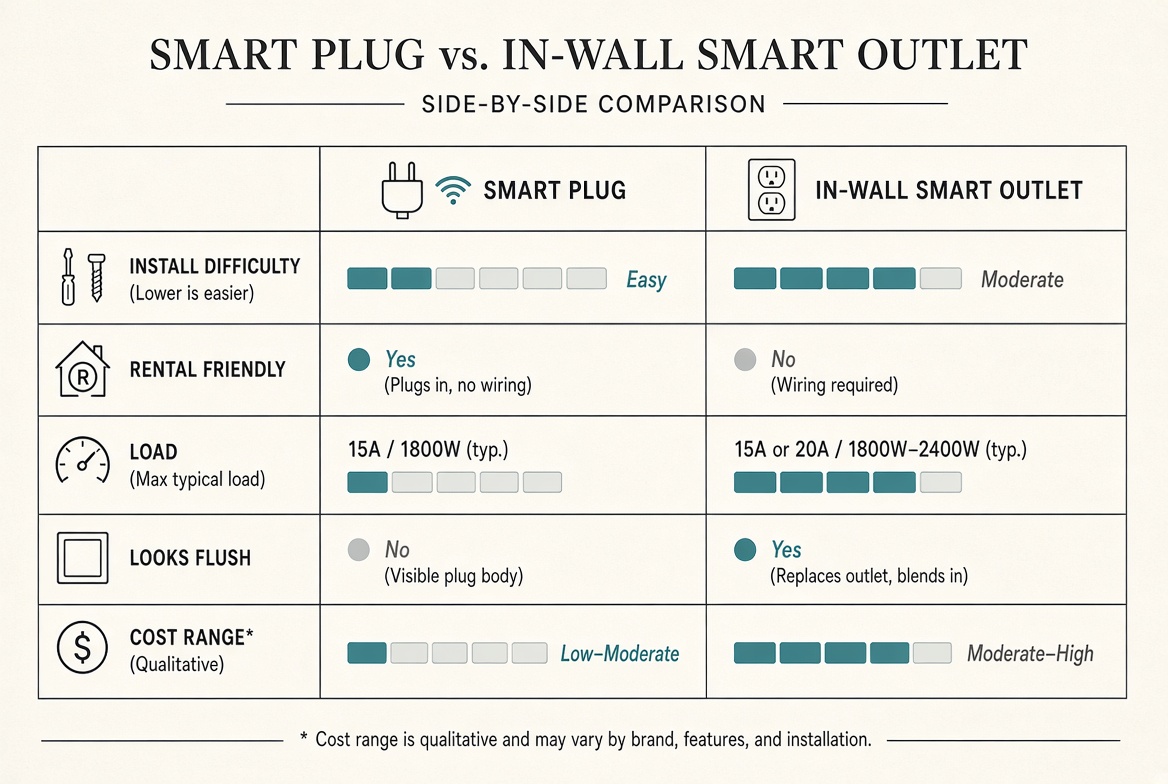
Side-by-side
| Smart plug | In-wall smart outlet | |
|---|---|---|
| Install | No wiring | Replaces receptacle |
| Rental friendly | Yes | Usually no |
| Looks flush | No | Yes |
| Typical load class | About 15A / 1800W | 15A or 20A depending on model and circuit |
| Move to a new home | Easy | Leave it or rewire again |
| Cost pattern | Lower device cost, no labor | Higher once labor is included |
Those load figures are typical, not universal. The printed rating on the device you hold is the one that counts.
When the plug wins
Use a plug for experiments. You may discover that a lamp does not need automation after all. You may discover that the 2.4 GHz signal is weak behind a sofa. Unplugging is cheaper than opening a box twice.
A plug also wins for seasonal loads: lights in December, a fan in August. Those devices should not dictate permanent wiring.
If you want the first-week path, return to the beginner guide.
When the outlet wins
Use an in-wall outlet when the receptacle is in a finished room you see every day and the appliance is staying. Living rooms with visible plates, kitchens where a plug would collect grease on a protruding body, and desks that already look crowded are common examples.
An outlet also wins when you want both sockets available and one of them switched. Some designs let the second socket stay hot so a nearby router does not die when the lamp turns off. That single feature prevents a surprising number of support headaches.
A third option people skip
If the lamp is controlled by a wall switch already, a smart switch on that circuit may beat both a plug and an outlet. The switch stays where your hand already goes. The fixture stays ordinary. The plug is then unnecessary. Do not stack a smart plug on a circuit you also intend to automate at the switch unless you like conflicting off states.
Safety notes that apply to both
Turn the breaker off before any in-wall work. Confirm the circuit with a tester. Follow local code. If you are not comfortable with that sentence, hire the work. A smart outlet is still an outlet. It carries household current.
For either device, keep high-heat appliances off the switched path unless the listing is explicit. Warm plastic at the plate is a stop sign. See also the troubleshooting guide if a new device feels hot or drops offline.
A short recommendation
Renters and first-time users should buy a plug. Homeowners who already know the outlet and the appliance will stay put can price an in-wall outlet plus professional installation. Most households end up with both: plugs for temporary and hidden spots, outlets for the two or three plates they look at every evening.
If cost is the reason you are choosing, read the energy estimates article before you assume either device will pay for itself.
Common mistakes
People treat the plug as a universal adapter for every cord in the house. That is how routers go dark, heaters overheat a relay, and duplex outlets lose their second socket. Limit the first month to lamps, fans, chargers, and seasonal lights. Expand only when those four are calm.
Another mistake is stacking control layers. A smart plug, a smart speaker routine, a vendor schedule, and a fixture switch all claiming the same lamp will look like random behavior. Pick one owner for on and off. Leave the fixture switch on. Keep a single schedule until that schedule is boring.
A third mistake is buying for a platform you do not actually use. A Matter or assistant badge is useful if you might change speakers later. It is wasted money if you only ever speak to one speaker and you already know that speaker’s catalog. Match the radio to the house you have this year.
A fourth mistake is ignoring the physical outlet. Loose receptacles, painted-over plates, and shared power strips change heat and contact quality. If the plug wiggles, fix the receptacle. No firmware update will tighten a worn socket.
What this publication can and cannot claim
Smart Home Ace can explain ratings, pairing paths, and planning math. It cannot certify that a specific model is safe in your walls. It cannot promise a dollar amount on your next bill. It cannot substitute for local electrical code or for a licensed electrician on in-wall work.
If a manufacturer lists a unique constraint, that listing wins. If your utility rate is far from the examples, replace the rate and rerun the arithmetic. If a device feels hot, unplug it. Those rules stay true even when the rest of the home is automated.
Questions worth asking before a second purchase
Did the first plug stay online through a router reboot? Did anyone in the house disable it out of irritation? Did the neighboring socket still matter? Did the yearly energy difference justify the price, or did convenience do the work? Answer those before you order a six-pack.
Households that like the first plug often copy the same pattern: one hidden lamp, one seasonal string, one charging tray. Households that disliked the first plug usually disliked bulk or unreliability, not the idea of a schedule. Those households should look at in-wall outlets or smart switches rather than a second bulky adapter.
Keeping the device boring on purpose
The best outcome is that you stop thinking about the plug. The lamp behaves. The app is a backup, not a hobby. That is the opposite of a dashboard full of tiles. If you find yourself opening the vendor app daily to fix the same drop, treat that as a defect in placement or in the radio plan, not as a need for more scenes.
Revisit the setup after a season change. Sunset times move. Holiday lights come down. A fan goes into a closet. Remove schedules that point at devices that have left the room. Stale automations are how people decide the whole category is unreliable.
Cost is more than the box price
A plug looks cheaper because the receipt is smaller. An in-wall outlet looks expensive because labor appears. Compare them over the life of the room. If you will move in two years, labor is wasted. If you will stare at the same plate for ten years, labor is a finish cost, like paint. Include the time you will spend resetting a bulky adapter that keeps getting kicked by a vacuum. That time is part of the price even though no store prints it.
Also include the second socket. If a plug forces you to buy a strip so the router still has a home, you did not save money. You bought another failure point. Count that strip in the comparison before you congratulate yourself for avoiding an electrician.
