
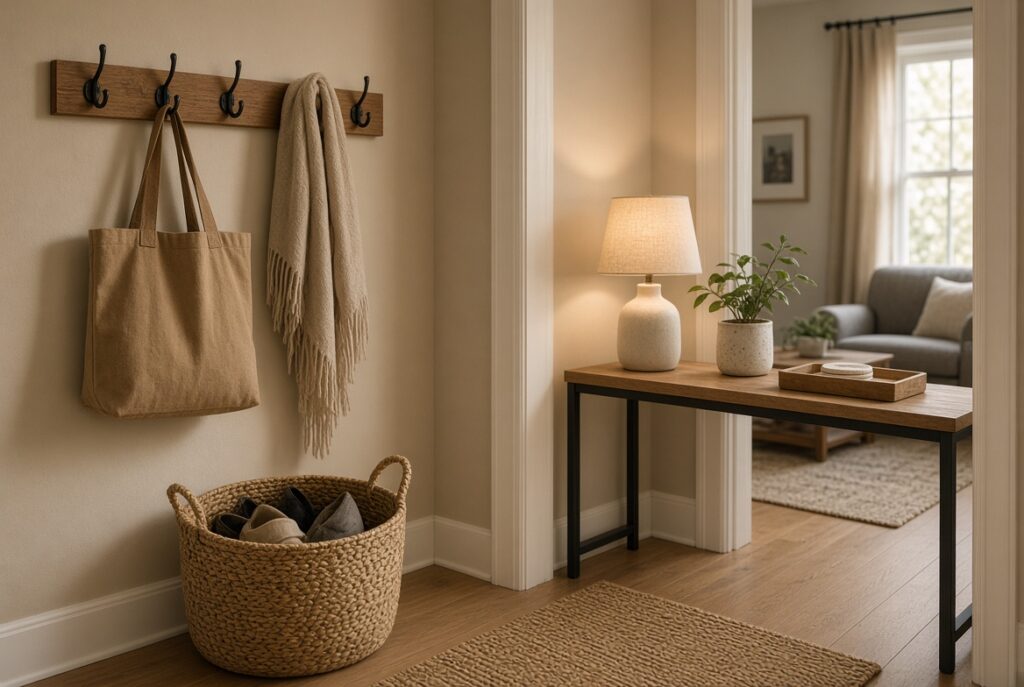
Not every improvement is a remodel. Most houses get easier to live in through a short list of small upgrades: a place to hang a bag, a lamp you will actually switch on, a drawer that does not fight you, a curtain that covers the glass. These changes improve comfort and everyday function at the same time.
This is not a numbered inspiration list and not a cart of gadgets. Use it when the plan says “this room, this month” and the budget is closer to hardware-store money than contractor money. More low-cost examples live in cheap room makeover and simple room makeover.
What makes an upgrade worth doing
A good small upgrade removes a daily friction or a daily ugliness, preferably both. Friction is the chair that collects clothes, the dark step at the back door, the utensil drawer that has to be excavated. Ugliness is the bare bulb, the towel on the floor, the pile of shoes in the walking lane.
If an upgrade only changes the photo and not the next Tuesday, skip it. That filter keeps you out of seasonal decor and inside the work of a makeover.
The door and the first wall
Give incoming objects a home before they reach the sofa. Hooks at adult height, a lower hook if kids use the door, a hard basket for shoes, and a surface for keys that is not the dining table. A lamp in that zone means you are not fishing for a switch with grocery bags on your wrist.
Use screws and anchors appropriate to drywall or plaster. Command hooks are fine for hats and light bags. They are not fine for winter coats on a hollow door.
If the entry is also a hallway, keep the furniture skinny. A console that sticks eight inches into a 36-inch hall is not an upgrade. It is a bruise.
Light you can place without a ceiling box
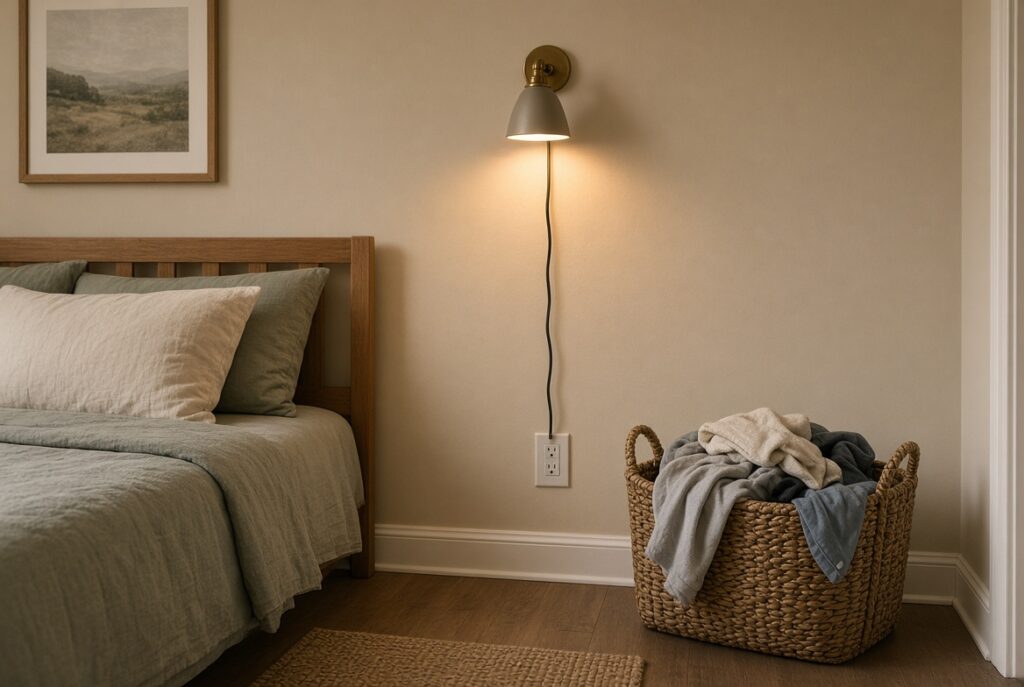
A plug-in lamp next to the chair you already sit in is the highest-yield upgrade in most living rooms. A plug-in sconce over a bed frees a nightstand and keeps the overhead off. A battery puck under a cabinet lights a sink.
Match temperature to the rest of the evening rooms. The lighting guide, how lighting changes a room, explains why a daylight bulb in a new sconce will still feel like a garage.
Storage that matches one pile
Name the pile, then buy the container. Utensils get a drawer divider. Sheets get one shelf and a label. Chargers get a single cup or a shallow box, not four decorative bowls. Laundry gets a hamper that stands where clothes currently drop.
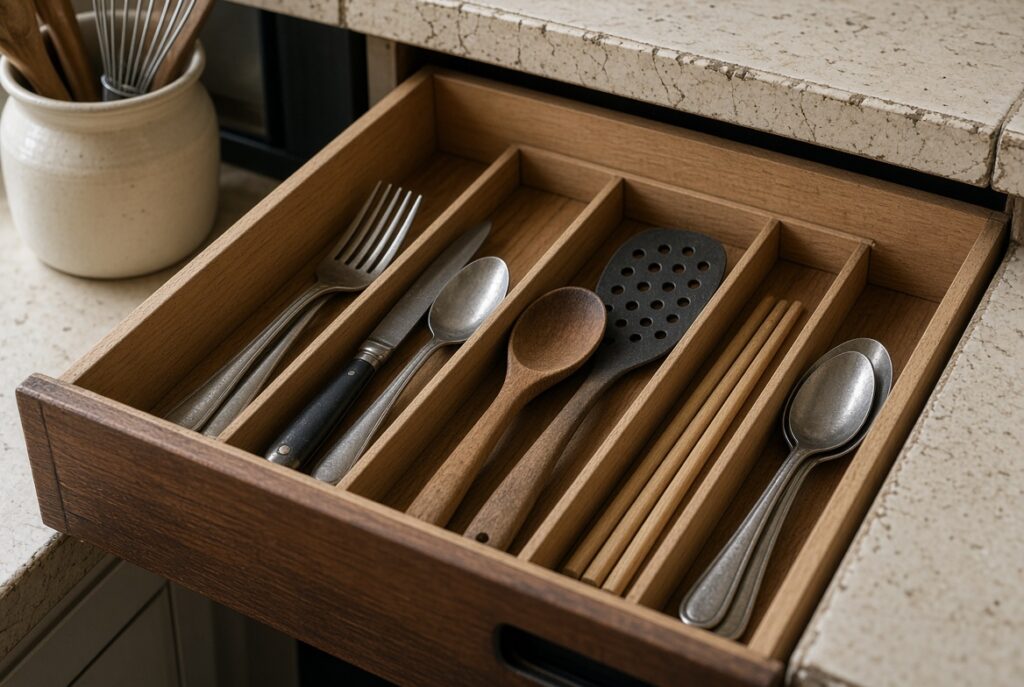
Closed storage beats open storage for mixed household stuff. Open shelves are for things you want to see. If you do not want to see it, give it a door.
In small rooms, go up the wall. Hooks, a rail, a shelf over the door in a closet. Floor space is the scarce material. The small room makeover archive is useful once you know which pile you are retiring.
Textiles that change temperature and acoustics
A rug that reaches furniture legs softens sound and gathers a seating group. Curtains hung high and wider than the window make the glass look intentional and cut glare on a television. A washable throw on the sofa you actually use will get used. A stiff decorative throw will become laundry on a chair.
Measure before you buy. Curtain length that hovers three inches above the floor looks accidental. A rug that leaves a two-foot ring of bare floor around a coffee table looks like a leftover.
Hardware you touch
Cabinet pulls, door stops, a better shower-curtain ring, a lid that actually sits on the trash can: these are function first. If you replace pulls, pick one metal and repeat it in the rooms you can see from each other. Random mixed metals on every drawer read as leftover hardware, not as collected taste.
Do not strip and refinish a kitchen as a “small upgrade.” That is a project. A pull and a drawer divider are upgrades.
Water, weather, and the unglamorous list
A dripping bathroom faucet, a toilet handle that needs two jiggles, a back-door sweep that lets in winter: these change comfort more than art. If you are not sure the repair is simple, stop and call someone licensed. This is a publication, not a plumbing manual.
Weatherstripping, a door sweep, and a showerhead you can stand under are comfort upgrades. They rarely show in before-and-after photos and they are why the house feels finished on a Tuesday.
- Hook rail and shoe basket at the door
- Two warm bulbs and one lamp relocated to a dark corner
- One drawer or one closet shelf brought to a single category
- Curtains rehung higher on the rod you already own, if the length allows
- A hamper where clothes currently land
- Cabinet pulls only if the existing ones fail or cut hands
Three is enough. Five is how a weekend becomes a half-finished house. Spend first using the spending order if you are choosing between this list and a sofa.
What not to call a small upgrade
A new sofa, a tile floor, a moved wall, a full closet system, and a smart-home hub are not small. They can be good later. They blow the point of this page, which is to make the current house easier this month.
Also skip upgrades that require a new personality. If no one in the house will fold a complicated organizing method, buy a lid and a label, not a 17-piece matching acrylic set.
How to judge the work on Monday
Did the pile stay gone? Did anyone turn the new lamp on without being asked? Can you walk from the door to the kitchen with bags in both hands? If yes, the upgrade worked. Photograph it if you want. The test is the week, not the picture.
When several rooms have had this kind of pass, the house starts to feel related even before paint. That is the moment to read how to pull rooms together, not the moment to start over.
Kitchen upgrades that are actually small
A cutting board that lives on the counter you already use, a tray that corrals oil and salt so you can move them to wipe, a lid for the trash, a better sponge holder so the sink edge is not a swamp. None of these are remodel ideas. All of them change Tuesday night.
Skip gadget drawers. A single extra tool you will not use is how the divider fails. If you have not used a tool this month, it does not need a nicer home. It needs to leave.
Bedroom upgrades that change sleep
Blackout or room-darkening panels on the window that hits your face at 5 a.m. A lamp you can switch without sitting up. A basket for the chair that currently is a dresser. Extra pillows that no one uses should leave so the bed can be made without a project.
If the mattress is the problem, that is no longer a small upgrade. Name it and use the spending guide. Do not buy seven organizers for a room whose main failure is the bed.
Maintenance is part of the upgrade
Wash the new curtain. Wipe the new pull. Empty the new basket. An upgrade that cannot take ordinary dirt is decoration. Choose materials you will treat the way you already treat the house, not the way a catalog treats a set.
