

Most wasted makeover money is not a scam. It is a reasonable object put in the wrong order, at the wrong scale, or on top of a room that still cannot do its job. The room looks busier. Walking gets harder. The overhead light is still awful. Then the next weekend tries to fix that with more objects.
This is a troubleshooting list for rooms that feel worse after “improvements.” Use it before you buy the next thing. It sits next to the planning guide and where to spend first.
Buying decor to cover a layout problem
If the sofa blocks the kitchen path, no tray styling will help. If seats face only the television and sit eight feet from each other, the room will talk poorly no matter how many candles you add.
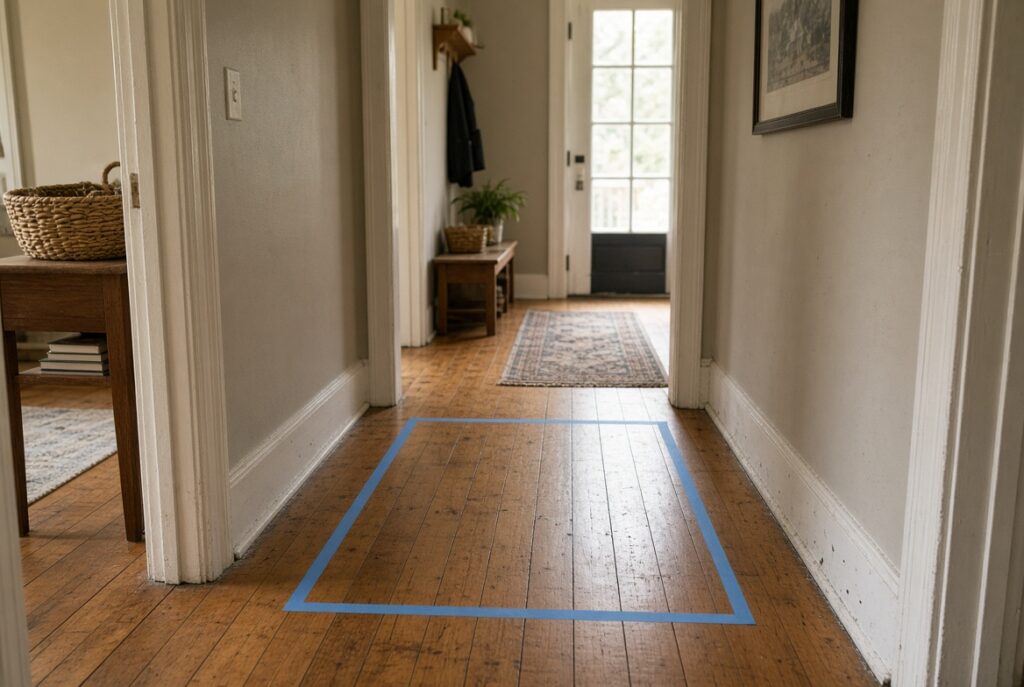
Fix the footprint first. Tape it. Move the large pieces. Then see what is still missing. A room that works with ugly furniture is closer to finished than a styled room you cannot cross.
A rug that is too small
A stamp-size rug under the coffee table makes the seating look like it is floating in a parking lot. Front legs of the sofa and chairs should land on the rug in a living room. In a bedroom, the rug should catch bare feet on at least one side of the bed, not float as a postcard at the footboard.
If the budget cannot cover the right size, wait. A too-small rug is not a starter rug. It is a second purchase waiting to happen. That mistake shows up constantly in living room makeovers that start with accessories.
One bright, cool ceiling light
A single cool-white disc or fan light flattens faces and paint. Adding more of the same on a dimmer still leaves the room lit from the top. The cheaper fix is a warmer bulb and a lamp at seat height. The more expensive fix is still not a second matching disc.
If you already bought “daylight” bulbs for every socket, you did not fail at shopping. You bought a utility temperature. Move those bulbs to closets, laundry, and workbenches. Put 2700K in rooms where people sit at night. See lighting as a makeover tool.
Filling every surface
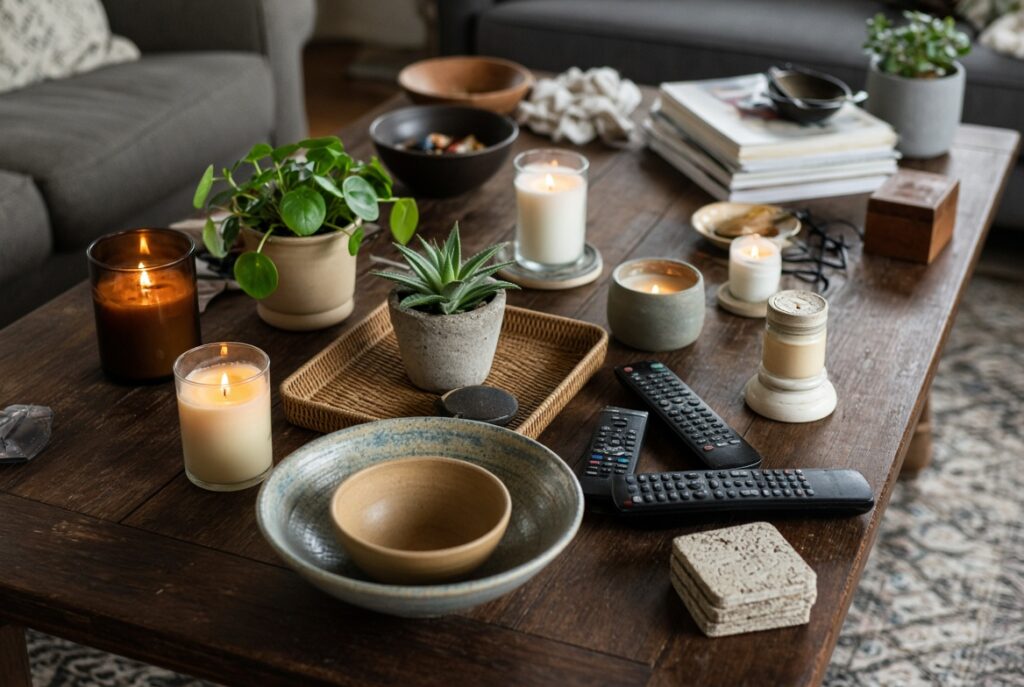
A coffee table that cannot take a mug is not styled. It is closed for use. Leave about a third of the main table clear. Two or three objects beat twelve. Remotes need a tray or a drawer, not a supporting role in a tablescape.
The same rule applies to bathroom counters and kitchen islands. Daily tools can stay out. Collections cannot occupy the only work surface.
Matching everything in one shopping trip
A boxed set of pillows, lamps, and wall art in the same print reads as a showroom, then dates as a unit. Mix materials the house already has: wood you already own, a metal that already appears on a door handle, fabric that can take a wash.
Matching is not cohesion. Cohesion is a few repeated temperatures and metals across rooms. That is a different job, covered in pulled-together rooms.
Paint before the furniture decision
People paint a wall a bold color to “start,” then the sofa they keep fights it, then they paint again. Sample the color on the wall and look at it at night next to the actual sofa. If the sofa is leaving this year, delay the paint.
Renters who paint without permission create a different waste: the cost of returning the walls. If you cannot paint, change textiles and lamps. The room will still shift.
Storage that does not match the mess
Open baskets collect mixed overflow and still look like overflow. A pretty jar set does not retire the pile of mail. Name the pile first: shoes, mail, chargers, kids’ art, extra chairs. Buy the container that closes or sorts that one category.
Vertical storage is usually better than another object in the walking lane. A hook rail beats a new console that sticks into the path. A shelf in the closet beats a second dresser in a small room.
Starting five rooms at once
Half-painted trim in three rooms is not momentum. It is a house that looks abandoned mid-project. Finish the path, light, and surfaces in one room before opening the next. The planning guide exists because this mistake is so common it feels like work ethic.
Treating before-and-after photos as a shopping list
Historical before and after posts can show what a rug or a cleared path does. They cannot tell you your ceiling height, your door swing, or your budget. Copy the test (night photo, clear path), not the object list.
Smart devices as a first remodel
A speaker, a camera, or a plug does not fix a blocked doorway. Technology is useful after the room has a job and a lamp. If a plug later helps a lamp on a timer, fine. Do not begin a makeover in an app store.
A recovery sequence for a room that already feels worse
- Clear the main table and the floor path. Box the extras for two weeks. If you do not miss them, they can leave.
- Change the overhead bulbs to warm white or turn that fixture off at night.
- Add or move one lamp to where someone sits.
- Pull seating into a tighter group or slide furniture off the walking lane.
- Only then decide whether the rug size, paint, or a single furniture piece is still the problem.
If the room improves after steps 1 to 4, you did not need a new theme. You needed the room to work. That is also the standard in the cozy living room mistakes guide, which is worth reading if the failing room is the one you sit in after dinner.
How to know you are about to waste the next $50
You are shopping hungry, late, or angry at the room. You are buying a set because it is on sale. You have not measured. You have not used the room for a week after the last change. Any one of those is a reason to wait until morning.
Makeovers that hold up are boring on the receipt: bulbs, hooks, paint samples, a rug in the right size, a lamp with a shade that hides the bulb. The expensive-looking rooms in this publication are usually those boring receipts plus time.
Scale mistakes that photographs hide
A chandelier that is right for a catalog room will sit too low or too small in yours. A sectional that filled a showroom will eat a 12-by-14 living room. Online photos crop out the walking lane. Your doorway will not.
Bring wall measurements in your phone. Stand in the store and mark the length with your arm span. If you are guessing, you are about to pay for a second trip. The same rule kills oversize coffee tables that leave no knee space and undersize art that dots a wall like leftover stamps.
The “more storage” spiral
Storage cubes in the middle of a small room are not storage. They are new furniture in the path. If the closet is a heap, the upgrade is an afternoon with bags and a label, not another cube. If the closet is already full of things you do not use, the upgrade is a donation run.
People also buy storage for a fantasy hobby. The guest-room craft wall that never happens still occupies the room. Make the room do the job it already has.
Color mistakes beyond the feature wall
Cool gray walls with warm oak floors and 2700K lamps can still work if the gray is not blue. Blue-gray with yellow oak and warm lamps will look dirty at night. Sample on two walls and look at 8 p.m. If you hate it only at night, that is the real color of the room.
High-contrast trim in a small room outlines every uneven corner. Soft related trim is quieter. Quiet is usually what people meant by “pulled together.”
