
Spending first on the wrong thing is how a makeover becomes a pile of packages and an unfinished room. The order that photographs well is rarely the order that makes a house easier to live in.
This is a decision guide, not a product list. It assumes an ordinary American house or apartment, a limited budget, and no design contract. Pair it with the whole-home plan so one room does not spend the year.
Spend where hours accumulate
Put money where bodies spend time: the seat you sit in after work, the counter you cook on, the bed you sleep in, the path you walk with grocery bags. A styled powder room is a poor first spend if the living room has no lamp and the kitchen has no clear landing zone.
Count hours, not square feet. A small kitchen used twice a day outranks a large formal dining room used at holidays. A bedroom you sleep in outranks a guest room that stays closed.
If two rooms tie, pick the one that greets you. The first ten feet inside the door set the tone for the rest of the house. A hook rail and a light in that zone often beat a new living-room chair.
Four spends that usually pay back
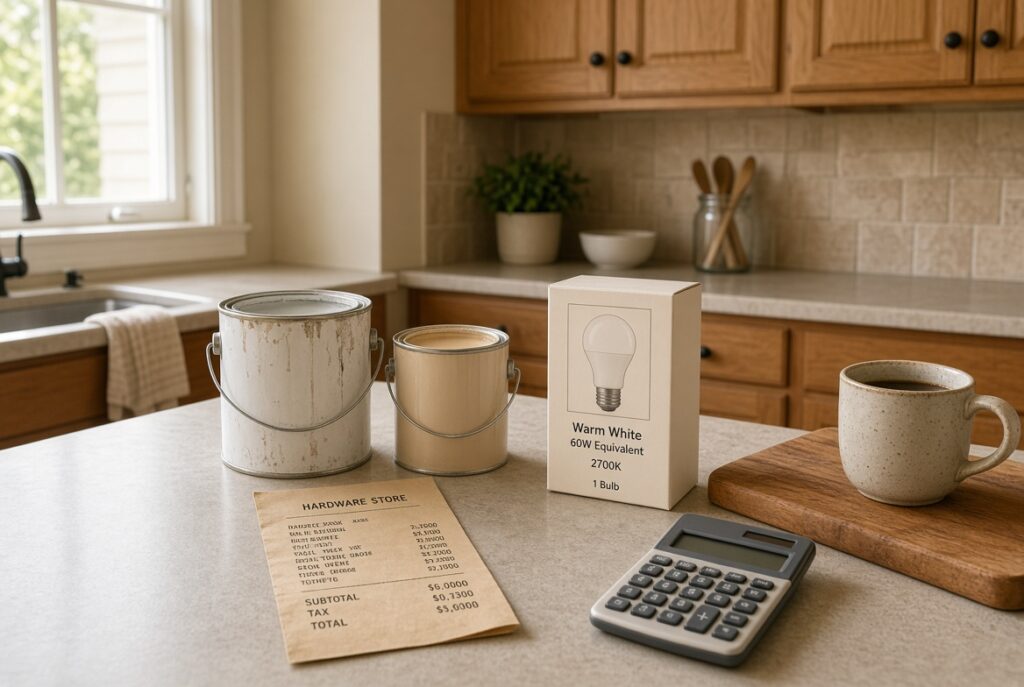
Light comes first because it changes every other surface. A cool-white ceiling disc makes new paint look cheap and old furniture look older. Warm bulbs near 2700K and one extra lamp at sitting or counter height are a better first receipt than a new throw set. Details live in how lighting changes a room.
Second is the walking path and the landing zone. If mail, shoes, and bags have no home, no sofa will look settled. A bench, a hook rail, or a single closed basket next to the door is furniture that works.
Third is the large textile that gathers a room: a rug big enough for front furniture legs, or curtains hung high and wider than the glass. Small pillows do not do this job.
Fourth is storage that removes daily overflow from view. A drawer divider, a lidded hamper, or a closet shelf that actually holds sheets will make a room look “redesigned” without a redesign. That is the point of a cheap room makeover when it is done honestly.
What to delay even if it is on sale
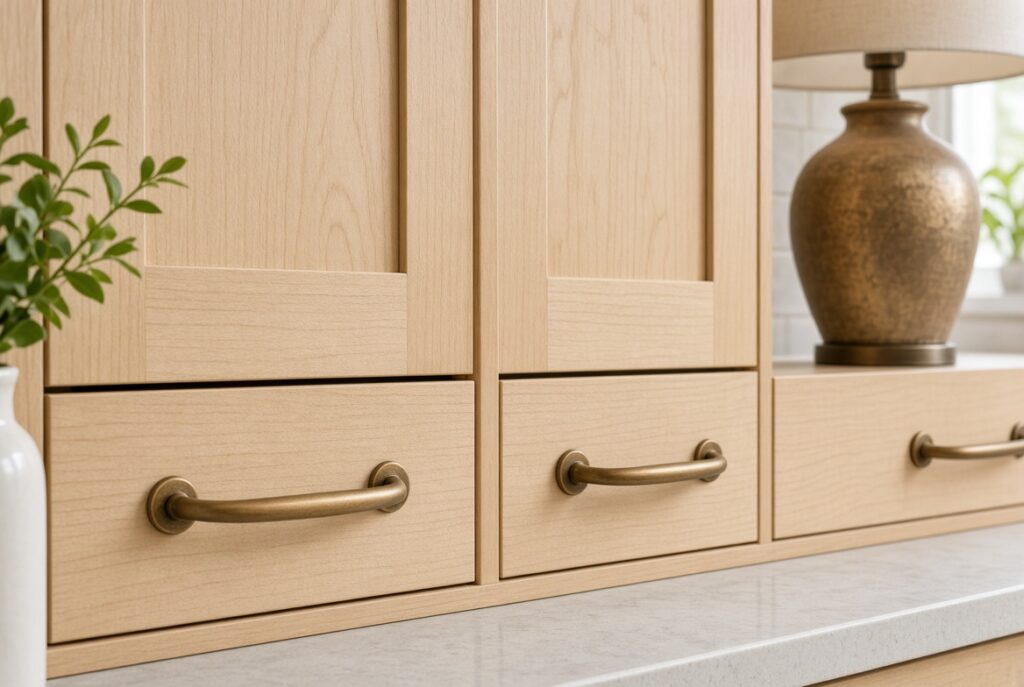
Delay matching furniture sets. Sets lock you into one scale and one wood tone before you know how the room is used. Buy the failing piece only.
Delay feature walls, seasonal collections, and anything sold as a “makeover in a box.” Those products assume the path, light, and storage are already solved.
Delay smart devices until the analog problem is named. A bulb that you can dim by hand solves more evening rooms than an app. If you later want a plug on a lamp, the smart plugs hub is there. It is not step one of a makeover.
Delay paint if you do not own the walls or if the furniture is still moving. Paint is cheap only when you do not have to do it twice.
A simple split for a $200, $800, or $2,000 year
At about $200, stay in consumables and small hardware: bulbs, a plug-in lamp, hooks, a shower curtain, drawer cups, and one plant you will water. Do not buy a sofa on that number.
At about $800, add one large textile or one storage piece that hides a daily mess, plus paint for a single room if you own it. Keep $100 back for the thing you discover after you live with the first changes.
At about $2,000, you can replace one failing workhorse: a mattress, a genuinely broken sofa, or a used table that fits the taped footprint. Do not split $2,000 across six rooms. Six rooms will each look 15 percent better and still feel unfinished.
These are planning ranges, not prices we verified in your zip code. Hardware-store costs move. The principle does not: concentrate money.
Room by room, the first dollar
Kitchen: clear 18 inches of landing space and fix the light over the work zone before you buy stools or a new rug. A $12 drawer divider can retire a countertop pile. More kitchen examples sit in kitchen remodel ideas, including work that is far above a first-year budget. Steal the functional ideas, not the full gut list.
Living room: lamp, then rug size, then seating distance. Decor last. The cozy living room guides cover seating distance and light without requiring a remodel.
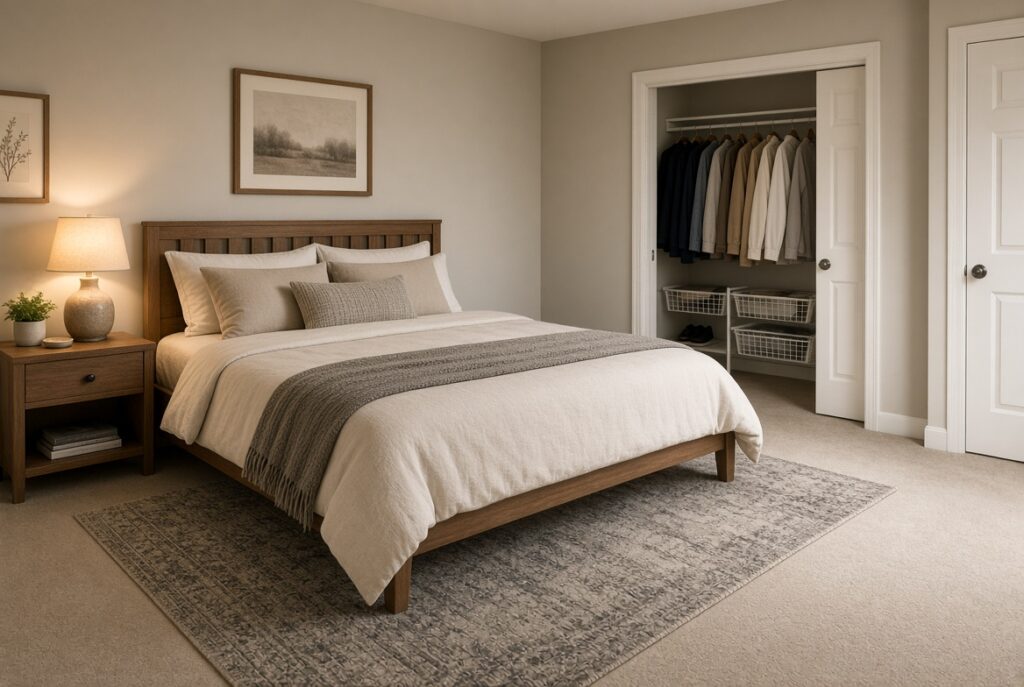
Bedroom: mattress or pillows if those are failing, then a lamp you can reach from the bed, then a place for clothes that currently live on a chair. Art can wait.
Bathroom: a curtain that is not transparent, a hook that is not a towel on the floor, and a bin for products you do not use daily. Tile can wait years.
Entry: hooks at the height people will actually use, a hard-sided tray or basket for shoes, and light that is not a bare bulb. If the entry is a hallway, treat the first wall as the room.
How to test a purchase before you make it
Ask three questions. Will I touch this most days? Does it remove a pile or a dark corner? Can I return it if the scale is wrong?
If the answer to the first two is no, it is decoration. Decoration is allowed after the room works. It is a poor first spend.
Bring a tape measure. Sit in the chair in the store. Unroll the rug edge with your foot. Look at bulb temperature on the box, not only wattage equivalent. Cool daylight bulbs belong in work benches more often than in evening rooms.
Protect the next room
Write the cap on paper. When the first room hits it, stop. The urge to “just finish” is how the second room loses its lamps.
Keep a running list of leftovers: extra bulbs, leftover paint, spare hooks. Use those in the next room before you shop again. Shared leftover paint is also how rooms start to relate. See pulled-together rooms before you buy a second wall color.
A one-afternoon spend that is hard to regret
Buy two packs of warm-white bulbs, one plug-in lamp, a hook rail, and a pack of command-grade or screw-in hooks appropriate to your walls. Install them in the darkest sitting spot and the messiest landing spot. Live with that for two weeks before the next receipt.
If the house already feels better, you have your answer about where money should go next: more of the same class of fix, not a different class of object. The small upgrades guide lists more of those fixes. The mistakes guide lists the ones that usually do not.
Hidden costs that blow a first-year cap
Delivery fees, return shipping on a wrong-size rug, primer when the wall was darker than you thought, and the extra gallon because the sample lied in noon sun. Leave a tenth of the room budget for those. If you cannot, you do not have that room budget yet.
Time is a cost. A $40 lamp you install tonight beats a $200 fixture that needs an electrician you have not called. Factor the week you will live with a half-painted wall. If you cannot stand that week, do not start the paint.
Used furniture without pretending it is free
A used table that fits the taped footprint is often the right spend. Check wobble, finish that will mark your floor, and whether it will fit up the stair. Measure the stair. People skip that and then own a table that lives in the driveway.
Skip used upholstered pieces you cannot inspect for sag and smell. A tired sofa at a bargain price is how the living room stays tired. If the seat is the problem, money belongs on the seat, even if that means the walls wait.
Spending questions for the store parking lot
Can I name the hour of day this helps? Can I return it? Does it repeat a metal or a temperature I already chose? If you cannot answer the first question, put it back. The house does not need more anonymous objects. It needs the next hour to be easier.
