

Basements can feel unfinished even when they have plenty of space, especially when a single overhead light leaves the corners dim and the layout hard to read.
I find that layered lighting can make the biggest difference when it responds to how the room is used, with focused task lights, softer ambient light, and a few accents to bring depth to darker areas.
The right combination can make a basement feel more comfortable for relaxing, working, or hosting without changing every surface.
It is satisfying to see a once-forgotten room become more useful through thoughtful choices rather than a major renovation.
I’d save the lighting approaches that suit your layout and test them one at a time, adjusting the brightness and placement to fit your home.
Use Layered Lighting To Finish The Basement

The bare basement becomes a comfortable living room once the ceiling lights, perimeter lighting, and wall sconces work together. That mix makes the space easier to use after dark than a single exposed bulb would.
For a similar result, combine general ceiling lights with softer lighting near seating areas, and put them on separate switches if possible. This works especially well in basements with little natural light; keep the bulbs warm but bright enough for everyday tasks.
Use Layered Lighting To Make A Basement Feel Cozy

A basement dining room can feel more welcoming when its lighting comes from several sources instead of one harsh overhead fixture. Here, recessed ceiling lights, a pendant over the table, and shelf lighting replace the fluorescent fixture, making the room feel more comfortable for both meals and projects.
Try this approach in a basement that serves more than one purpose. Use general ceiling lights for everyday tasks, then add focused lighting where people gather or work. Put lights on separate switches if possible, so you can adjust the room without making every corner equally bright.
Turn A Bare Basement Into A Home Theater

A basement can feel more finished when it has a clear purpose. Here, an unused room becomes a home theater, with tiered seating and recessed ceiling lights replacing the open, cluttered layout. Keeping the lighting low and adding wall sconces gives people enough light to move around without washing out the screen.
This idea works well in a basement with a raised section or steps. Use dimmable lights in more than one spot, and keep the brightest fixtures away from the screen. A few well-placed lights are more useful than one harsh ceiling bulb.
Use Layered Lighting To Make A Basement Laundry Room More Usable

A dim laundry room can feel more practical with several light sources instead of one bare bulb. Here, track lights overhead and a light strip beneath the cabinets brighten the work area and make the basement feel more finished.
Use general lighting for the whole room, then add focused light above counters or other places where you sort and fold clothes. In a small basement, keep fixtures compact and make sure the light reaches the work surfaces without creating glare.
Turn Basement Storage Into A Reading Nook

An unused basement storage area can become a comfortable reading nook with built-in bookshelves and lighting at more than one level. Here, the recessed shelf lights make the books easier to see, while the ceiling lights and floor lamp provide light around the chair.
Start by clearing the area and deciding where you’ll sit, then plan lighting for both the shelves and the reading spot. This works especially well in a basement alcove, where a few well-placed fixtures can make a small space useful without crowding it.
Turn A Basement Bar Into A Comfortable Gathering Spot

The bar feels more usable after the bulky counter and mismatched stools give way to a slimmer seating setup. Warm pendant lights over the counter and a lit shelf behind it make this basement corner feel ready for people to gather, rather than just a place to store bottles.
For a similar setup, focus the lighting where people sit and work, then add a softer glow to shelves or the wall behind the bar. This works well in a basement with limited natural light; keep the fixtures and seating scaled to the space so there is still room to move around.
Turn A Bare Basement Bedroom Into A Finished Room

An empty basement bedroom can feel cold and unfinished, especially when the walls and floor are worn. Here, a properly dressed bed and bedside lamps make the space feel like a real bedroom, while recessed ceiling lights provide general light.
For a similar room, use more than one light source: ceiling lights for overall brightness, then table or wall lamps near the bed. Choose warm bulbs, and keep the switches easy to reach so the room is comfortable to use at night.
Use Lighting To Make A Basement Hallway Feel Finished

A dim, worn hallway can feel more cared for with lighting at more than one level. Here, a ceiling light is replaced by a warm strip of light along the ceiling and floor, with small wall lights highlighting framed art. The wood floor helps the corridor feel less stark, too.
For a similar effect, use a low-profile LED strip along one edge of the ceiling or baseboard, then add a few wall lights where you want gentle pools of light. Choose warm bulbs and keep the brightness comfortable for a passage people use at night.
Use Layered Lighting To Make A Basement Office More Usable

The basement office feels more practical once the harsh, single ceiling light is replaced with several light sources. A desk lamp handles close work, while shelf lighting and track lights brighten the rest of the room without relying on one overhead fixture.
Use the same approach in a basement workspace or other dark room: light the desk for tasks, then add softer illumination around the room. Keep the bulbs warm but bright enough for work, and aim lights away from the screen to reduce glare.
Make A Basement Gym Feel More Finished

The basement gym works better when layered lighting replaces a single harsh overhead bulb. Recessed ceiling lights brighten the workout area, while warm light along the walls gives the room a more finished feel.
For a similar setup, use even overhead lighting so weights and equipment are easy to see, then add softer accent lights near the walls or a mirror. Keep the light bright enough for safe workouts without relying on one glaring fixture.
Make A Basement Playroom Feel Finished

The empty basement becomes a usable playroom by pairing practical storage with layered lighting. Recessed lights brighten the room, while the colorful pendant and low lighting beneath the bench give it a softer glow where kids play and read.
For a similar setup, start with even overhead light, then add a focused light or two near the main activity area. Keep bins and shelves easy for children to reach, and avoid filling the floor so there is still room to play.
Use Layered Lighting To Make A Basement Kitchen More Usable

The old kitchen felt dim under one ceiling bulb, while the updated version uses recessed lights, under-cabinet lighting, and pendants to brighten different areas. That mix makes the counters easier to use and gives the room a more comfortable feel.
In a basement kitchen, start with general ceiling light, then add task lighting where you prep food and softer fixtures over a counter or seating area. Keep the bulbs a similar warm tone so the layers work together rather than feeling mismatched.
Create A Basement Bar And Lounge With Warm Ambient Lighting

A basement bar can feel more like a storage area when it has harsh overhead light and no clear place to sit. Here, warm lighting around the bar and ceiling helps the room work as a relaxed spot for drinks and conversation.
Use a few kinds of light instead of relying on one bright fixture: add focused light at the bar and softer fixtures near the seating. This works well in a basement with dark wood, but keep the bulbs warm rather than dimming the whole room until it is hard to see.
Turn An Awkward Basement Entry Into Useful Storage

The space under the stairs works better when it has a clear purpose. Here, a crowded coat and shoe area becomes a built-in entry nook, with a bench and hooks that keep everyday items in one place. Recessed lights and a wall lamp make the small area easier to use, too.
For a similar spot, fit storage to the shape of the stairs and leave enough room to walk through comfortably. A bench with shoe shelves below is practical in a narrow basement entry, while a few well-placed lights help you find coats and shoes without relying on one dim ceiling bulb.
Use Layered Lighting To Upgrade A Basement Wine Cellar

The cellar feels more usable after the old single bulb is replaced by warm lighting along the wine racks. That steady glow makes the bottles easier to find and gives the narrow room a more finished feel.
In a basement cellar, combine shelf lighting with a small ceiling fixture or a task light near a counter. Use warm, low-glare bulbs, and keep the wiring suited to the room’s humidity. You do not need bright light everywhere; focus it where you reach and work.
Turn A Basement Workbench Into A Useful Workspace
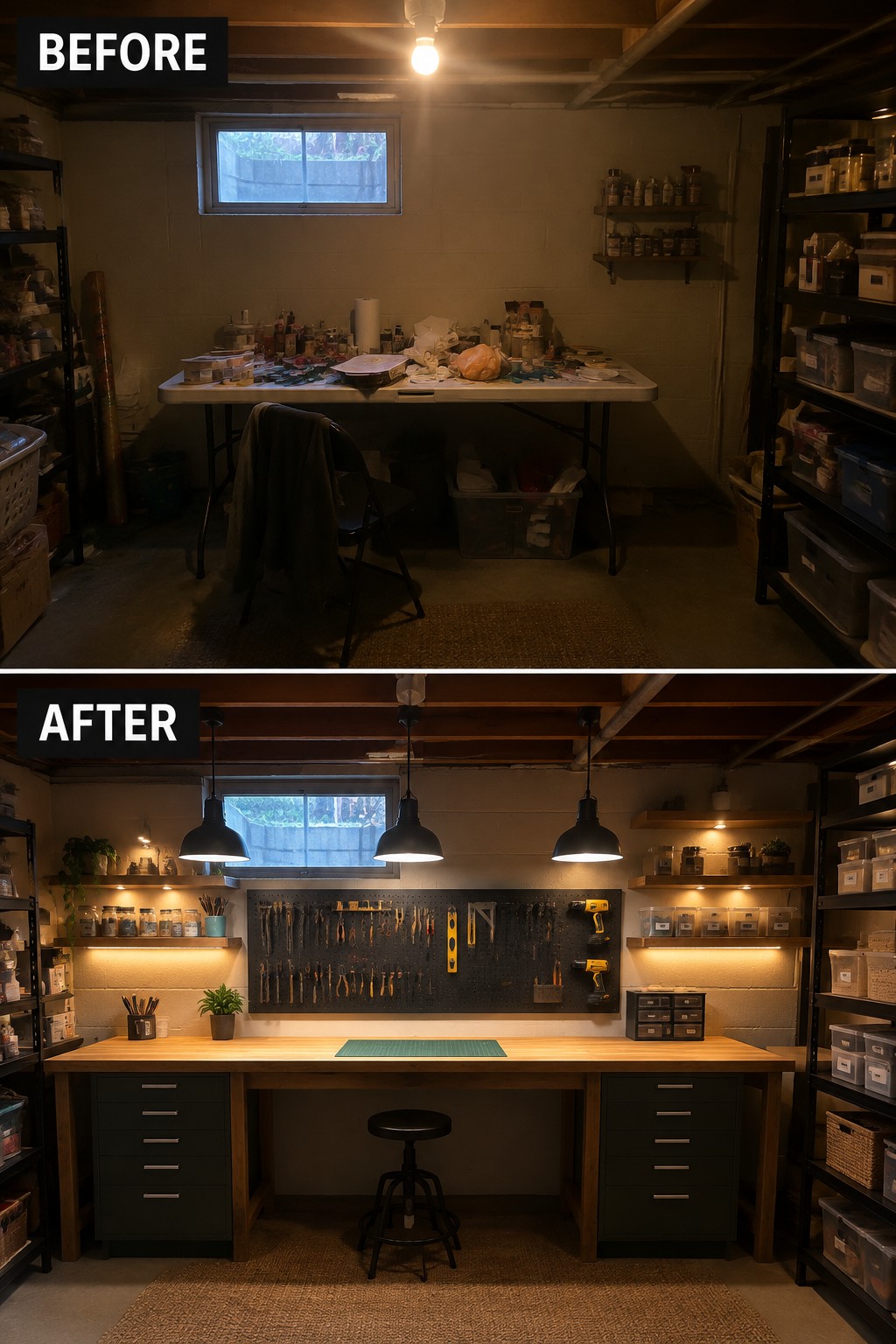
This basement goes from a cluttered folding table to a clear workbench with tools organized nearby. The layered lighting makes the work surface easier to use and keeps the basement from relying on one dim ceiling bulb.
For a similar setup, put focused light over the bench and add softer lighting around the room so you can see both your project and the surrounding area. This works well in a basement workshop, craft corner, or hobby space, especially where small windows provide limited daylight.
Create A Cozy Basement TV Room With Cove Lighting And Lamps

A plain basement can feel cold when one ceiling light does all the work. Here, warm cove lighting and lamps make the TV area feel more settled, while the larger screen gives the room a clear focal point.
Use a mix of ceiling, indirect, and task lighting, placing lamps near seating and keeping the main lights dimmable. This approach works well in a basement lounge, where softer light makes movie watching comfortable without leaving the whole room in the dark.
Use Layered Lighting To Make A Basement Bar More Welcoming

A basement bar can feel cold when one bare bulb does all the lighting. Here, warm lights around the taps and shelves, along with ceiling fixtures, make the bar easier to use and the seating area more comfortable.
For a similar setup, combine general ceiling light with focused lighting at the bar and a softer fixture over the table. Put the lights on separate switches if possible, so you can brighten the room for serving and keep it lower during a relaxed gathering. Avoid relying on decorative lights alone; the work areas still need enough light.
Set Up A Basement As A Simple Photo Studio

A bare basement can become a useful photo studio without a major renovation. Here, a roll-down backdrop and brighter overhead panels replace an empty, dim corner, giving the room a clear purpose.
If you want to try this at home, start with a backdrop that fits the space and add adjustable lights aimed at the shooting area. Keep enough open floor space to move equipment around, and use the existing basement storage rather than crowding the setup.
Make A Basement Workbench Easier To Use
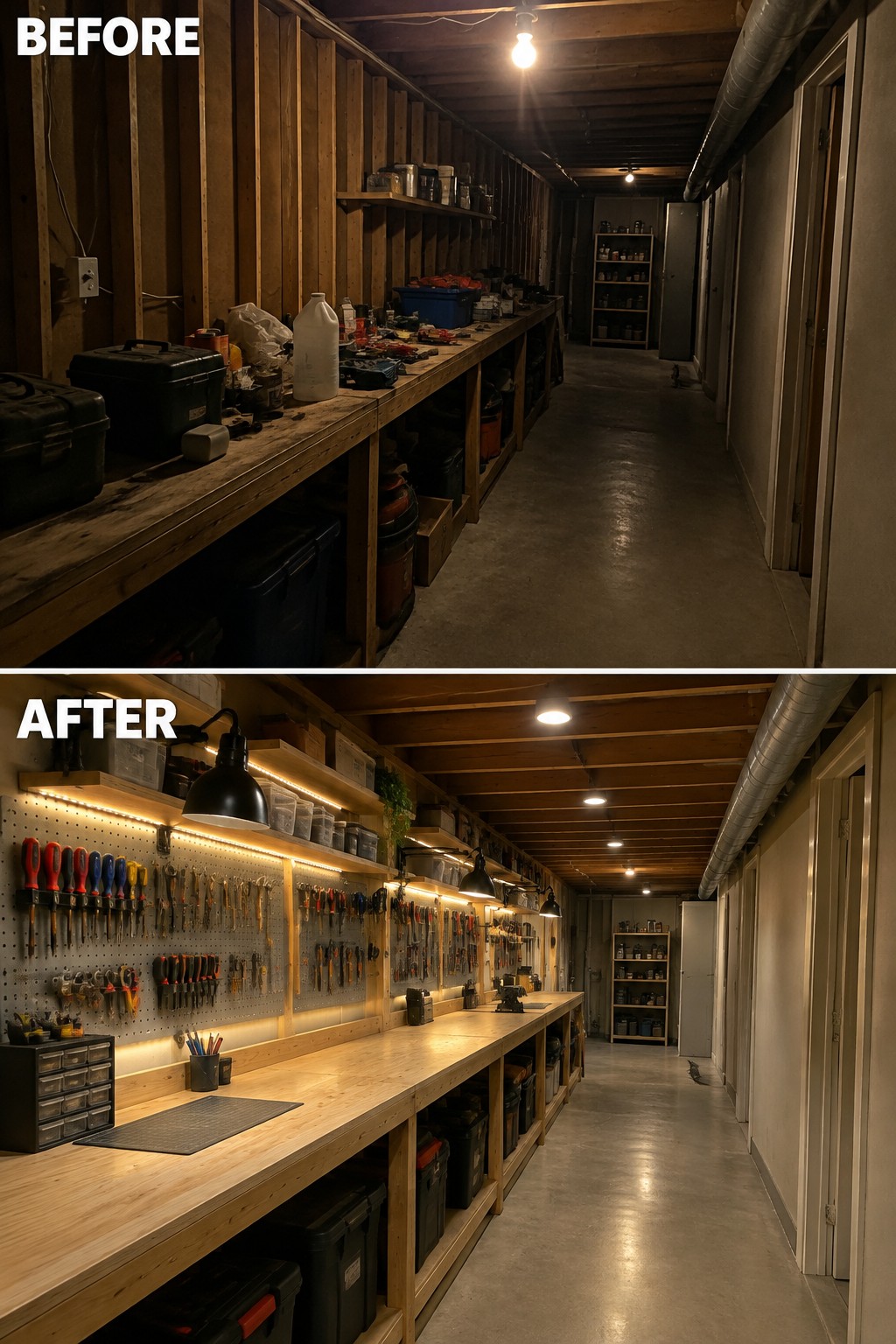
A cluttered workbench can make basement projects harder than they need to be, especially when the room is dim. Here, clearing the bench and adding task lights along the tool wall makes the workspace easier to use without changing its basic layout.
For a similar setup, keep the main work surface open and place focused lights where you handle small parts or tools. In a basement with limited daylight, combine task lighting with general overhead light so the whole area stays usable.
Use Layered Lighting To Make A Basement Music Room More Usable

A single bare ceiling bulb can leave a basement music room feeling dim and unfinished. Recessed lights and track spots brighten the room, while warm accent lighting near the instruments makes the practice area feel more comfortable.
For a similar setup, combine general ceiling light with focused light where you read music or play, and use low-level accent lights to give the room a softer feel. Keep the light sources on separate switches if possible, so you can adjust the room for practice or just listening.
Make A Basement Sewing Room Easier To Use

A sewing room works better when the task area is bright and the rest of the room isn’t left in the dark. Here, a desk lamp and shelf lighting replace the dim, uneven light, making the work surface easier to use while giving the basement a more finished feel.
For a similar setup, combine general ceiling lights with focused lighting at the table and shelves. This is especially useful in basement workrooms without much daylight. Aim the task light at the sewing surface, and keep the shelves bright enough to find supplies without relying on one harsh overhead bulb.
Brighten A Basement Game Room With Pendant And Counter Lighting

The basement bar feels much more usable after the harsh overhead light is replaced by a mix of warm ceiling lights, pendants, and counter lighting. The room still serves as a game space, but the softer light makes it comfortable to spend time in.
For a similar effect, keep some general lighting for moving around, then add focused lights above the bar or seating area. Warm bulbs work well in a basement, especially when the room has dark walls. Avoid relying on a single bright fixture, which can leave the rest of the space feeling gloomy.
Use Layered Lighting To Make A Basement Workroom More Usable

A single bare bulb leaves a basement workroom feeling dim, even when there is a table to use. Adding ceiling lights and focused pendants makes the work surface easier to see and gives the room a more settled feel.
For a similar setup, use general lighting across the room, then add task lights above the main work area. Put the lights where you need them, and avoid relying on one bright fixture to cover every corner.
Transform A Bare Basement Into A Sitting Area With Recessed Lighting

A single bright ceiling fixture can leave a basement feeling stark, even when the room is large. Here, recessed ceiling lights and smaller lamps help turn an empty concrete-floored space into a comfortable place to sit, with the lighting spread across the room instead of coming from one spot.
For a similar effect, use overhead lights for general visibility, then add focused or low-level lights near seating areas. Warm bulbs work well in a basement, but keep the light bright enough for everyday tasks and leave clear paths through the room.
Frequently Asked Questions
Q: How can I make a basement feel brighter without adding more ceiling lights?
A: Layer light at different heights. Add a floor lamp beside the sofa, a table lamp on a shelf, or wall sconces to brighten shadowy corners without making the ceiling feel crowded.
Q: What color light bulbs work best in a basement?
A: Warm white bulbs usually make a basement feel more inviting, especially in rooms with little natural light. Choose bulbs with a similar color temperature so the lighting feels calm rather than patchy.
Q: Can I use dimmer switches with layered lighting?
A: Yes, and they make it easy to shift from bright task lighting to a softer evening glow. Check that both the dimmer and bulbs are labeled as compatible before installing them.
Q: How do I light a basement with a low ceiling?
A: Use flush-mounted ceiling lights and add lamps or sconces to spread light around the room. Avoid tall, hanging fixtures that can make the ceiling feel even lower.
